AQTIVATE Article: Rethinking the Code: My Quest to Make Scientific Software as Adaptable as its Hardware
March 27, 2026Upcoming AQTIVATE Conference: September 28th – October 2nd, 2026
April 27, 2026The art of compression: From cartography to quantum simulations
by Asmita Datta
Hi! I am Asmita and I work at the interface of quantum algorithm simulation and tensor networks. When I first started working in this field, most of the stuff seemed really cool from a distance but quite technical to be understood by a layman. Here’s an attempt to “compress” my work: keeping what is cool and discarding what is technical.
Take an example of navigation apps like Google Maps, an application that you use often in your lives. You can use it to plot a route from your doorstep to a café across the city, recalculate in real time when you take a wrong turn, estimate your journey time depending on real-time traffic conditions and do all of this in a matter of seconds. What it could never do however, is store a perfect, atom-by-atom map of every road, building, and pavement crack on Earth. That would require more storage than exists in the world.
Instead, your phone stores a compressed map. It keeps the things that matter for navigation road names, junctions, speed limits, approximate distances and throws away everything else. The map is not the whole reality. It is a carefully chosen approximation of reality, precise enough to be useful, compact enough to actually implement.
My research basically extends this analogy to the simulation of quantum systems. Because quantum simulation face exactly the same challenge, just with considerably stranger mathematics.
Quantum systems govern almost everything interesting in nature. The way electrons behave in a material determines whether it behaves as a regular conductor or becomes a superconductor. The way molecules interact at the quantum level shapes how drugs bind to proteins and how chemical reactions unfold. These questions sit at the heart of materials science, chemistry, and medicine. And yet our ability to simulate quantum systems from first principles remains deeply limited.
The reason is a brutal mathematical fact. In the quantum world, particles exist in superpositions of many states at once, and when particles interact, their states become entangled. To describe a collection of particles fully, you must account for every possible combination of their states simultaneously. Add one more particle, and the complexity doesn’t grow by one step, it doubles. By the time you reach a few hundred particles, the number of configurations you’d need to track exceeds the number of atoms in the observable universe. No classical computer can hold that much information.
Quantum computers, in principle, sidestep this wall by using quantum mechanics itself as a resource. But today’s quantum hardware is noisy, error-prone, and limited. The gap between what it can potentially do and what it does currently is quite large. So the real question becomes: how do we extract the most useful physics from the limited quantum resources we actually have?
This is where tensor networks come in and they bring with them the same philosophy as GPS maps. Don’t represent everything. Represent what matters.
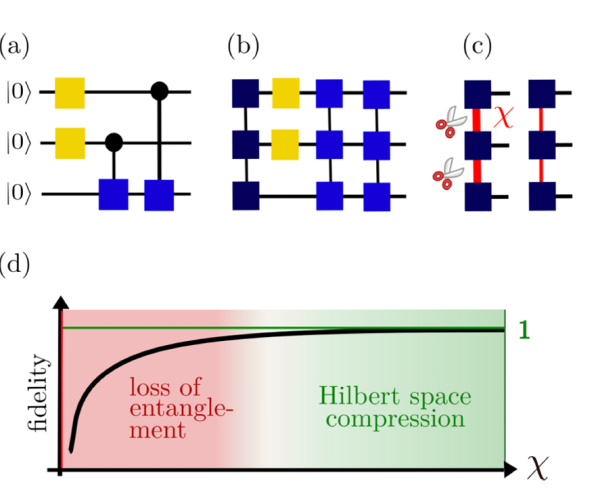
A tensor network encodes a quantum state not as one enormous, high dimensional object, but as a collection of smaller, low-dimensional, interconnected mathematical pieces. Each piece captures local behaviour between a small group of particles, and together they reconstruct the global quantum state with remarkable accuracy. The key insight is that most physically meaningful quantum states don’t actually use all that exponential complexity. Real systems are structured: particles interact mostly with their neighbours, correlations weaken with distance, and the most important quantum information is concentrated in specific, identifiable places. Tensor networks are built to exploit exactly this structure.
My research explores what happens when you bring these ideas directly into the design of quantum algorithms. Take Shor’s algorithm, a quantum procedure that can factor enormous numbers exponentially faster than any known classical method, with profound implications for modern cryptography. Running Shor’s on real hardware means executing deep, layered quantum circuits where entanglement builds up in intricate, structured ways across many steps. The question I work on is: can we use tensor networks to classically simulate and understand these circuits? By representing the circuit as a tensor network, I try to understand exactly how quantum information flows through each layer, identify where the genuine computational complexity is concentrated, and gain insight into the limits of simulating quantum algorithms using classical techniques; without needing a fully operational quantum computer to do it.
The most powerful quantum computers of the future will almost certainly not work by brute force. They will work by being clever about structure, about knowing which parts of a problem genuinely require quantum treatment, and which can be handled classically.